
Systems Design, Creative Lead
Barton is by far the most ambitious project I’ve worked on. As a sophomore at DigiPen, I decided to lead a huge team of students through a game project, based on an experimental system to support an NPC that can respond dynamically to player dialogue. I’d been messing around with open dialogue systems before (See my PAX West 2024 talk!) and I really wanted to:
Make a fun, intentionally designed game with a talking NPC. (Someone should tell NVIDIA to look into this)
Demonstrate how a game system can be designed to support conversation as a meaningful mechanic.
Find patterns in how players interact with an AI NPC in the context of a game.
The Pitch:
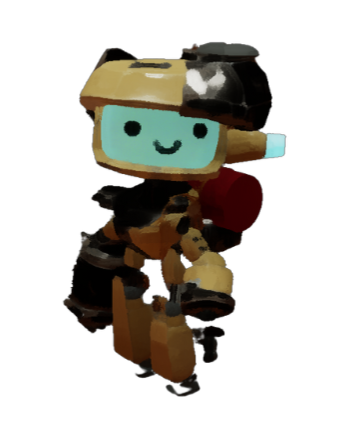
What I pitched to my team at the start of this project was a simple concept at heart: a game about cooperation. Inspired heavily by Portal 2’s co-op levels, we wanted to make easily-readable puzzles where the challenge comes from getting a little robot to do stuff for you. An open-dialogue system is already a weird new mechanic for players to learn, so we didn’t want to overload them with crazy complicated puzzles, and instead find interesting ways to trick players into caring about their little robot friend, Barton.
The essence of an open dialogue system is that the dialogue generated by the character changes depending on what players input into the dialogue system. In other words, the personality of the character changes depending on what players say to it. This also means that—because no two players ever say the exact same thing—that every player will have a Barton unique to them and their play through.
The Process:
This page is being written right now! Sorry for the construction, stay tuned for updates.